|
 |
 |

|

|
 |
 |
 |
 |
 |
 |
 |
 |
 |
 |
 |
 |
 |
 |
|
|
|
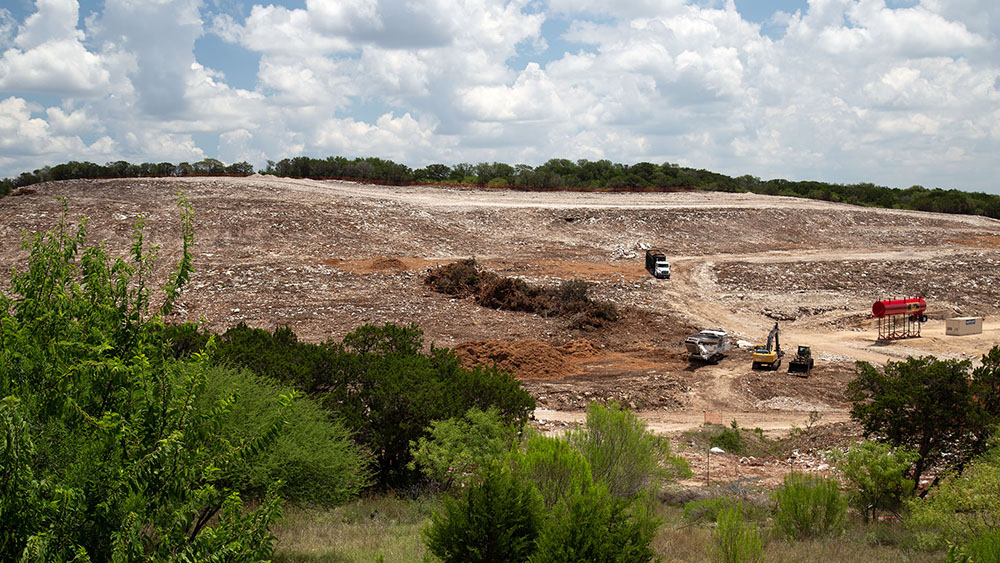
Task force convenes for review of policies in wake of Legend Hills controversy Earlier this year, controversy erupted when 38 acres of land near the Legend Hills subdivision were cleared for a new luxury apartment complex. The controversy focused on potential disruption of habitat for the endangered Golden-cheeked Warbler and other cave creatures, but the site is also over the Edwards Aquifer Recharge Zone. The work was eventually allowed to proceed (see previous News Flash). In December of 2018, a new city task force began a review of the city's development process to make sure city officials are fully aware of real estate projects in environmentally sensitive areas. City Councilman Manny Pelaez said "They're going to be working through new standards and protocols to make sure that doesn't happen again." Although consultants for the development firm maintain no habitat for endangered species was disrupted, the U.S. Fish and Wildlife Service is conducting a criminal investigation to determine if violations of the Endangered Species Act occurred at the property. One particular issue the task force will examine is the city's "habitat compliance form", which developers are required to complete for properties of at least two acres that contain potential endangered species habitat. In this case, a study was used in support of the form that was more than the required three years old, and the study examined only Warbler habitat and not cave creatures. Many residents in Legend Hills were originally drawn to the area by sensitive development that preserved many of the original trees and Hill Country character. Marty Wender, the original developer in the 1980s, tried to protect the natural aesthetics of the hilly terrain. In contrast, the current development is a complete clear-cut, with portions of the hills removed. "It always surprises me when people do that," said Wender. "When you're out in the Hill Country, to me the asset is the Hill Country." Warning issued on global warming, Edwards Aquifer In December of 2018, the federal government issued its Fourth National Climate Assessment. It warned the Edwards Aquifer could be at risk in the next 50 years as a result of warmer temperatures and more frequent and severe droughts, compounded by population growth. It stated "These climate changes will be exacerbated in central Texas' rapidly urbanizing regions, as increasing impervious cover will affect water quality and rates of runoff and recharge." It also predicted "a degradation of habitat for species of concern." Chapter 23 of the report contains a case study of the Edwards Aquifer, you can download it here and read it for yourself. Iconic catfish farm well is plugged In 1991, Ron Pucek brought many of the region's water issues to a head when he opened his Living Waters Artesian Springs catfish farm in southwest Bexar county. Because the "right of capture" prevailed, he was free to take as much water from the Aquifer as he could put to a beneficial use. His use of water was a psychological turning point for the region, where people recognized that regulation of Edwards pumping was inevitable and necessary. In December of 2018, the iconic well was plugged by the San Antonio Water System, which had acquired the farm, well, and associated pumping rights in three transactions from 2000 to 2003. The well had deteriorated because of elevated minerals and temperature that are common in the Edwards near the fresh/saline water interface, so it really needed to be plugged. For the complete story of Mr. Pucek's farm and pictures of the plugging, see the page on Ron Pucek's Catfish Farm. |
||||||||||||
|
New Riverheads album features songs about San Marcos River and Springs and the people who protect them Recording artists The Riverheads have released Sacred Springs River Home, a collection of original songs about the San Marcos River and Springs. The album is a fundraiser for the San Marcos River Foundation. James Baker, also known as Captain Salamander, wrote the lyrics and performs lead vocals while playing acoustic guitar. The one man band known as Steve Collins served as recording engineer while playing additional instruments and providing re-arrangements. There are many different styles on the album - folk rock, easy listening, rap, 1950s rock, hard rock, and grunge, so there's a song style for almost everyone. Having been an avid music fan myself for more than 50 years now, with a ticket stub collection exceeding 700, I will say this album is pretty good and would make a great stocking stuffer for your favorite San Marcos River fan. The album is available in digital download and CD formats. For ordering information visit www.theriverheads.com.
|
||||||||||||
|
San Antonio reverts to Year-Round water restrictions On October 2, after the wettest September on record, San Antonio dropped its Stage 2 water restrictions and entered Year- Round restrictions. In San Antonio, 16.86 inches of rain fell in September, making it the third wettest month in recorded history. The J-17 index well rose more than 35 feet. San Antonio's Year-Round restrictions are:
|
||||||||||||
|
SARA and UTSA announce collaboration on water quality study In September the San Antonio River Authority and the University of Texas at San Antonio announced a $2.67 million funding agreement to study the relationship between land cover and water quality, with a focus on replacement of forest cover with impervious cover. The funding comes from the sales tax approved by public referendum for Aquifer protection and linear parks. It is well known that replacing forested areas with impervious cover like asphalt, rooftops, and concrete will degrade runoff water quality, and the study will quantify those effects locally in the Leon Creek watershed. Samples of runoff from four developed and non-developed areas will be collected for the purpose of comparison. The study will also examine the effects of Low Impact Development techniques, which include bioswales, vegetative filter strips, and sand filtration, all designed to improve the quality of stormwater runoff. UTSA will build a 2,000 square foot "Living Laboratory" on its main campus for this component of the study, which is also intended to function as an outdoor classroom. The study will run from January 2019 to September 2021, and UTSA will continue to operate and maintain the Laboratory for a minimum of 25 years. |
||||||||||||
|
Medina county shops for Bexar support in lawsuit on transfers of irrigation rights On August 24, Medina County Judge Chris Schuchart appeared in Bexar County Commissioners Court to ask for support in the intervention in the lawsuit that challenges new EAA rules on transfers of irrigation rights (see News items below). "We need that water to convert for our growth, just like Bexar county needs that water to convert for your growth," Schuchart said. Several Bexar County Commissioners were supportive but a motion to join the lawsuit was withdrawn to give the District Attorney's office time to review the case. Commissioners said they would reconsider the issue at their next meeeting on September 4. Work allowed to proceed near Legend Hills In June of 2018, residents of a far northwest side neighborhood were alarmed when 38 acres of tree-covered land were cleared for a new luxury apartment complex. The ensuing media discussion focused on trees and habitat for the threatened Golden-cheeked Warbler, but the site is also over the Edwards Aquifer Recharge Zone.
At first, city officials said the developer was not only complying with the city's tree preservation ordinance, he was exceeding it by leaving other acreage as a buffer zone between the new apartments and the neighboring houses. But by early July, work at the site was ordered to stop when concerns arose the developer might not have given complete information to city officials in a report that claimed no endangered species habitat would be destroyed. The Express-News obtained a copy of the report and noted that it focused only on bird habitat and did not include endangered karst invertebrates, small beetles and spiders that live underground in cave openings. Also, the study was completed five years before the developer filed plans with the city, but studies are required to be less than three years old. City Councilman Manny Pelaez hosted a heated neighborhood meeting where residents vented their frustration. Pelaez said "I'm angry too. I'm just as disappointed as you guys. It looks like a strip mine." By late July, the developer was facing a federal inquiry by the U.S. Fish and Wildlife Service. Spokeswoman Lesli Gray said "If it's determined that there's been a violation of the Endangered Species Act, then the developer could be subject to penalties. But we're not at that point yet." Meanwhile, the developer submitted a new report prepared in 2016 that concluded there was "potential suitable habitat" for warblers and karst invertebrates and it recommended checking one possible karst feature. That site was checked in 2016 and the author concluded it wasn't karst habitat. By early August, San Antonio city council members approved the creation of a task force to fix shortcomings in the city's permitting process for real estate projects in environmentally sensitive areas. On August 17, city officials said the new paperwork submitted met the city's requirements and they had little choice but to let the work continue. A few days later, Councilman Paleaz called for local and state authorities to investigate the real estate developer involved. Officials also noted the developer had been informed of his option to join the Southern Edwards Plateau Habitat Conservation Plan, in which developers can buy habitat credits and avoid the bureaucratic process of ensuring they won't run afoul of the Endangered Species Act. The developer declined. UTSA funded for DNA-based flowpath study On August 8, UTSA announced it would receive a grant of $125,000 to use DNA-based tracers to characterize the recharge and flow paths of the Edwards Aquifer. The grant is from Southwest Research Institute's Connecting through Research Partnerships Program. Ron Green, of SwRI's Space Science and Engineering Division, said "It's very difficult to discern flowpaths in the Edwards Aquifer. The bed of the waterway is made up of limestone, which has partially dissolved over time, creating a honeycomb structure that makes it impossible to visually identify the water's path." To address this difficulty, the researchers will use a new class of DNA-based tracers that are capsules containing a synthetic, double-stranded DNA that is unique to each tracer. The system allows for the fabrication of thousands of unique tracers that can be simultaneously distinguished from one another. After they are released and later collected, the information can be used to determine their path through the Aquifer. The approach could lead to the rapid detection of the source of contaminations, and it could be used to calibrate surface and groundwater models. Medina county supports intervention in lawsuit on transfers of irrigation rights On August 2, Medina County Commissioners authorized County Judge Chris Schuchart to act on the county's behalf in participating in the lawsuit described just below regarding transfers of irrigation rights. The intervention would be to support the EAA rules changes that expand the circumstances under which base irrigation rights can be transferred to another use. As described just below (and elsewhere on this page), Uvalde County Underground Water Conservation District and City of Uvalde oppose the new EAA rules. At the Medina County Commissioner's meeting, Precinct 3 Commissioner David Lynch asked "What is Uvalde hoping to gain or accomplish?" and Judge Schuchart summed up the issue rather concisely: "They don't want water leaving Uvalde county and being sold to Bexar county." |
||||||||||||
|
Hondo and Castroville support intervention in lawsuit on transfers of irrigation rights On July 23, Hondo City Council approved contributing $20,000 towards the possible intervention in a lawsuit filed against the EAA in January over new rules that make it easier to transfer water rights for agricultural irrigation when a property is no longer used for agriculture. When Edwards pumping rights were allocated, most agricultural users got two acre feet of water for every acre of land. They were allowed to sell one of them, but the other "base" acre-foot had to remain with the land unless land use changed to say, a warehouse instead of a cornfield. In December of 2017, the EAA adopted new rules that expanded the circumstances by which the second or base acre-foot of water can be sold. These include re-zoning that excludes agriculture and acquisition by an entity with power of condemnation or eminent domain. In practical terms, this would mean that a public water utility that has power of condemnation or eminent domain could buy the property and transfer both acre-feet of water to another use such as municipal supply. The possibility that additional water might be transferred to municipal use in Bexar county seems to be at the heart of the opposition to the new rules. So in January, the Uvalde County Underground Water Conservation District and George and Carolyn Ligocky filed suit in state district court in Uvalde to challenge the new EAA rules. The City of Uvalde joined the lawsuit in February. Hondo Mayor Jim Danner explained "Uvalde County [Underground Water Conservation District] and the City of Uvalde are suing EAA because they want to change that rule and leave that base water with the property no matter what. We have development coming and we need people to be able to sell that base water if they change the use of their agricultural property." On July 24, the city of Castroville also agreed to contribute $5,000 toward possible intervention in support of the EAA. |
||||||||||||
|
Court ruling upholds EAA Board structure On June 18 U.S. District Judge Orlando Garcia upheld the current balance of power in the governing Board of the Edwards Aquifer Authority with a ruling the current structure is not unconstitutional. The League of United Latin American Citizens and San Antonio Water System had argued the EAA's Board structure violates the Equal Protection Clause of the 14th amendment because its districts don't reflect population distribution. Advocates for the current structure say the system was a compromise among urban and rural people who all depend on the same water source. EAA Board Chair Luana Buckner said "The court's decision solidifies the carefully constructed balance struck amongst regional stakeholders when the EAA was created and will allow the EAA to continue to provide the highest level of services to all users of the Aquifer in a fair and equitable manner." SAWS attorney Steve Kosub said the ruling "means the voting power of a Bexar County voter is dramatically less than the voting power of a member of the other counties within the EAA jurisdiction." Garcia's ruling left open the possibility that LULAC and SAWS could pursue an additional claim under Section 2 of the Voting Rights Act. LULAC had previously agreed to stay its claim the EAA structure improperly dilutes minority votes in Bexar County. San Antonio enters Stage 2 water restrictions On June 12, with the 10-day average of the J-17 well falling below 650', San Antonio entered Stage 2 water restrictions. In Stage 2, the hours for outdoor watering with a sprinkler or irrigation system are shortened. It's allowed from 7 - 11 a.m. and 7 - 11 p.m., one day per week, based on the last number of your address:
Water waste, such as water running down the street, is prohibited year-round. However, watering with a handheld hose is still allowed any day, any time. If you live outside San Antonio, check with your local municipality to see what the rules are for your location. |
||||||||||||
|
UTSA funded to develop Aquifer protections at Loop 1604 campus Almost no one remembers now, but back in the early 1970s the proposed location of a new UT campus in San Antonio was very controversial because the site is over the Edwards Aquifer Recharge Zone. When I got there in 1977, my geology professor talked about all the sinkholes that had been filled in to create parking, and he suggested that perhaps some sinkholes that remained SHOULD have been filled in so stormwater would not go into them. Back then, it was normal practice for cars to leak oil and coolant. More than 40 years later, it was announced that UTSA has received a three-year grant for $1,057,408 to remove contaminants from rainwater runoff and develop best practices for protecting water quality in the Recharge Zone. The Express-News reported that UTSA will use low-impact development techniques to treat runoff from 9.5 acres of rooftop and parking surfaces, removing such contaminants as fertilizer, bacteria, and hydrocarbons from automotive fluids. Environmental science professor Janis Bush said that aside from giving science and engineering students experience in low-impact development, the project will also provide an "outdoor classroom" on water quality issues related the the Edwards. "And we will be collecting valuable data on water quality that can be used in the future to inform management decisions," she said. San Antonio enters Stage 1 water restrictions On May 21, with the 10-day average of the J-17 well falling below 660', San Antonio entered Stage 1 water restrictions. In Stage 1, outdoor watering with a sprinkler or irrigation system is allowed only before 11 a.m. and after 7 p.m., one day per week, based on the last number of your address:
Watering days begin and end at midnight; overnight watering is not allowed. Water waste, such as water running down the street, is prohibited year-round. However, watering with a handheld hose is still allowed any day, any time. If you live outside San Antonio, check with your local municipality to see what the rules are for your location. SAWS CEO Robert Puente said “Despite the cooler weather and rain we’ve received this year the region’s water use has driven aquifer levels to drop. We have an ample supply of water from the Edwards and several other sources, but state law requires us to cut back on pumping when the Edwards Aquifer reaches certain levels.” Through May 31, SAWS is offering its water customers $100 or $200 coupons to replace water-intensive grass with drought-tolerant garden beds or permeable patios. Residue from metal plating shop found in Edwards wells On May 15 the U. S. Environmental Protection Agency announced the addition of a site to the National Priorities List for cleanup under the Superfund program. The site is on Potranco Road about a mile outside Loop 1604, where the former River City Metal Finishing company operated from 1994 to 2002. Hexavalent chromium, or chromium-6, has been detected in two wells that serve about 900 people in the Coolcrest neighborhood south of the River City site. Chromium is an odorless and tasteless metallic element that is found naturally in rocks, plants, soil and volcanic dust, and animals. The two most common forms of chromium that occur in natural waters in the environment are hexavalent chromium, and trivalent chromium, or chromium-3. Chromium-3 is an essential human dietary element that is found in many vegetables, fruits, meats, grains, and yeast. Chromium-6 occurs naturally in the environment from the erosion of natural chromium deposits. It can also be produced by industrial processes such as metal finishing. Currently, EPA's Maximum Contaminant Level for both types of chromium is 100 parts per billion. They are not measured separately because they can change back and forth between forms in the body. In order to ensure that the greatest risk potential is addressed, EPA's regulation assumes that a measurement of total chromium is 100% chromium-6. The standard is based on potential adverse skin effects over many years, such as allergic dermatitis. EPA also has a cancer screening risk level for chromium-6 in tap water that is much lower than Maximum Contaminant Level for total chromium. That level is 0.05 parts per billion. The levels detected in the two Coolcrest wells were 0.232 and 0.194 parts per billion. Besides hexavalent chromium, EPA said it also detected cyanide, lead, cadmium, copper, selenium, and zinc in soil and shallow groundwater below the River City site. Now that the site has been added to the National Priorities List, it will be eligible for federal funding for long-term cleanup. No hexavalent chromium was detected in 2017 in any wells used by the San Antonio Water System, according to SAWS spokeswomen Anne Hayden. |
||||||||||||
|
LULAC and SAWS file update in EAA Board structure lawsuit It has been six years since a lawsuit was filed by the League of United Latin American Citizens challenging the structure of the Edwards Aquifer Authority Board. Members from Bexar county represent far fewer people than members from other counties, and LULAC sued claiming that arrangement is unconstitutional because it results in unequal representation, favoring less populated counties over Bexar county, which is majority Latino. On March 19, LULAC and SAWS filed an advisory with the Western District Court in San Antonio, pointing out "the passage of time since the matter was submitted." The advisory also pointed out that 10 of the 15 seats on the EAA Board are up for re-election in November. Western counties and also the cities of San Marcos, New Braunfels, and Uvalde argued the current Board structure, although it doesn't conform to a one-person one-vote principle, represents a carefully crafted compromise that ensures all interests are heard, including recreation and farming. In Bexar county, each member of the EAA Board represents about 244,000 people, while the average representation for all Board members is 86,166 people. EAA maintains the Board was constructed that way "for a very clear reason, because it was to bring all the various parties together." On the other side, SAWS attorney Steve Kosub said "There's no question the voting power of the Bexar county voter is dramatically less than anyone else's. The issue grows worse as Bexar county grows." |
||||||||||||
|
City of Uvalde joins lawsuit against EAA In early February, the City of Uvalde joined the lawsuit described below, which centers on EAA's rule for conversion of agricultural water rights to other uses. The plaintiff's attorney Celina Romero said that Uvalde's participation is "welcome news" and they "look forward to other area governfmental entities joining us in this fight." Uvalde officials said the city's economy would be threatened by loss of agricultural activity and the impact that would have on other businesses, should more water be transferred to other uses. |
||||||||||||
|
Lawsuit filed over EAA's rule change for transfer of irrigation water On January 16, the Uvalde County Underground Water Conservation District and George and Carolyn Ligocky filed suit in state district court in Uvalde to challenge rules changes made by EAA that make it easier to transfer irrigation water rights to other uses such as industrial and municipal. The original legislation that created EAA provided that 50 percent of water rights granted in an initial permit for irrigation "must pass with the transfer of the irrigated land." In other words, farmers could only sell half their water. But there were provisions to allow additional transfers in cases where land could no longer be farmed. In December 2017, the EAA expanded the circumstances in which rights can be converted to other uses by adding categories for land that can no longer be used for agriculture because of rezoning, or acquisition by an entity with power of condemnation or eminent domain. The plaintiffs contend that EAA has no authority to alter the law in this way. The lawsuit states the amended rules will result in greater pumping from the Edwards, forcing Uvalde county property owners to rely on shallow non-Edwards wells, and it asks the court to permanently prevent EAA from taking actions under the new rules. Celina Romero, attorney for the District and the Ligockys, said "The state legislature did not empower the Edwards Aquifer Authority to alter a provision of state law and we have a high level of confidence that the courts will agree with us." State Representative Tracy O. King, who represents the area in the Texas Legislature, also said the EAA lacks authority to make the rule change. "In this legislative district, water is a key resource, and I am unconvinced that the Edwards Aquifer Authority's rule change is supported by the authority the legislature granted them. Before any of my constituents are adversely affected, or business interests in my district harmed, this issue absolutely needs to be fully vetted," King said. EAA had a different take on the matter. Chairwoman Luana Buckner issued a statement in which she stood by "our position that governmental entities are required to acknowledge the private property rights that exist in groundwater as the courts and lawmakers have determined. Our base irrigation groundwater conversion rules, which are the subject of this lawsuit, were developed 17 years ago and have evolved over time as an accommodation of those property rights so that owners of this type of groundwater could continue to exercise their rights if and when economic and market influences changed the nature of their property so that it could no longer be farmed. We look forward to defending this position on behalf of holders of Edwards groundwater rights." In other words, EAA framed the issue as protecting private property rights, which courts in Texas almost always appear to favor.
|